


JijModeling 2.7.0 Release Notes#
Feature Enhancements#
Improved compiler speed and memory efficiency#
Major compiler optimizations have substantially improved execution speed and memory efficiency 🎉
Benchmarks show speedups of up to 8x over JijModeling 2.6.0 and up to 5x over 1.14.2. The representative execution times below are normalized to 1.0 for 2.7.0. A larger value means that the comparison version took longer than this release.
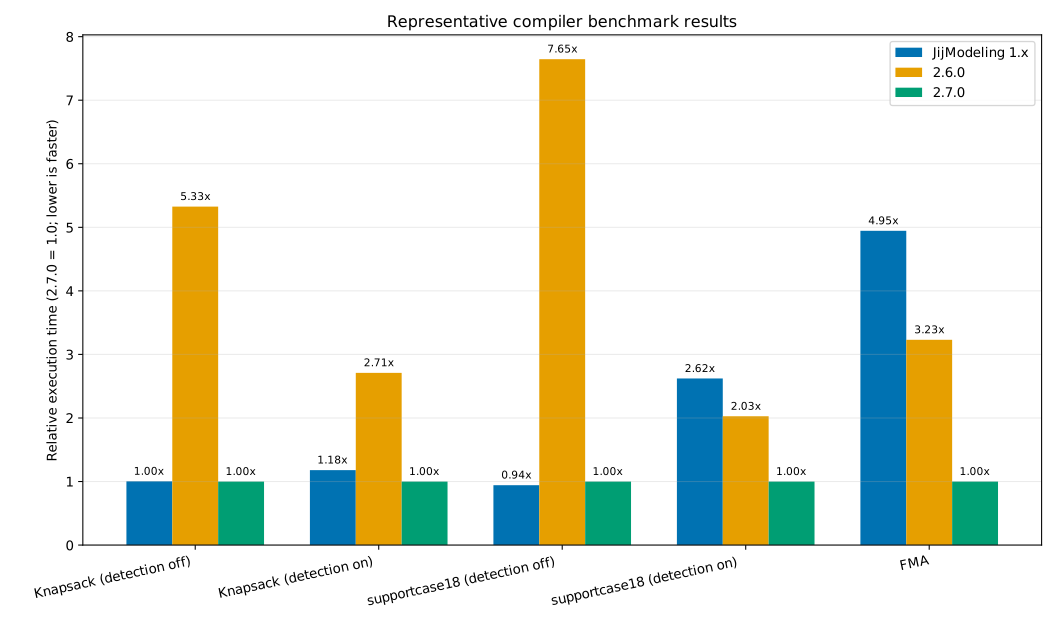
Fig. 7 Relative compilation time in representative benchmarks. The labels above the bars are ratios to 2.7.0 (1.0 or higher means that 2.7.0 is as fast or faster).#
Memory allocation per compilation has also decreased substantially. Specifically, the total memory allocated per compilation decreased by 76–97% compared with 2.6.0 and by 51–94% compared with 1.14.2.
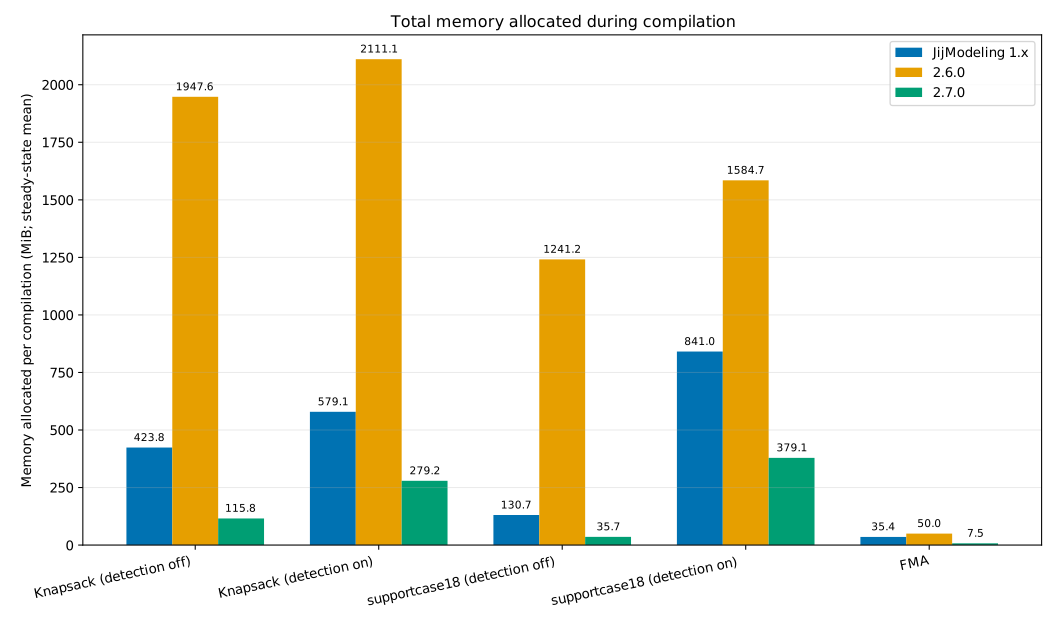
Fig. 8 Total memory allocated per compilation in representative benchmarks#
All benchmarks were run on a Google Cloud n2-standard-8 VM (8 vCPUs, 32 GB, Ubuntu 26.04 LTS, x86_64).
Models whose compilation time is a bottleneck can benefit substantially from these improvements, so please consider migrating to JijModeling 2.
Automatically obtain parameters when using the update decorator API#
Previously, when using @Problem.update, you’d have to manually obtain
already-defined objects (eg. decision variables, placeholders) by
accessing problems.decision_vars and the like. Now, you can define additional
parameters to the function which will be automatically obtained (by name) from
that problem.
import jijmodeling as jm


@jm.Problem.define("MyProblem")
def problem(problem):
    w = problem.Float(ndim=1, description="Weights of the items")
    N = w.len_at(0)
    W = problem.Float(description="Total weight")
    x = problem.BinaryVar(shape=(N,), description="Selected items")


@problem.update
def _myupdate(
    problem: jm.DecoratedProblem,
    w: jm.Placeholder,
    W: jm.Placeholder,
    x: jm.DecisionVar,
):
    problem += problem.Constraint("weight", jm.sum(w * x) <= W)

    # as before, you can still define new variables and placeholders:
    v = problem.Float(ndim=1, description="Values of the items")
    problem += jm.sum(v * x)


problem
Improvements to the Type Mismatch error#
The Type Mismatch error now includes the term whose type actually mismatched when needed.
import jijmodeling as jm


try:

    @jm.Problem.define("MyProblem")
    def problem(problem: jm.DecoratedProblem):
        N = problem.Length()
        W = problem.Float()
        x = problem.BinaryVar(shape=N)

        problem += x[W]  # Error!
except Exception as e:
    print(e)
Traceback (most recent last):
    while checking if expression `x[W]` has type `float!`,
        defined at File "/var/folders/mg/mg6st30d18s7pxjjrk6pkxym0000gn/T/ipykernel_47462/2016213372.py", line 12, col 20-24
    while inferring the type of expression `x[W]`,
        defined at File "/var/folders/mg/mg6st30d18s7pxjjrk6pkxym0000gn/T/ipykernel_47462/2016213372.py", line 12, col 20-24
    while inferring the type of expression `x[W]`,
        defined at File "/var/folders/mg/mg6st30d18s7pxjjrk6pkxym0000gn/T/ipykernel_47462/2016213372.py", line 12, col 20-24
    while checking if type `Array[N; binary!]` can be subscripted with (W): (float),
        defined at File "/var/folders/mg/mg6st30d18s7pxjjrk6pkxym0000gn/T/ipykernel_47462/2016213372.py", line 12, col 20-24
    while checking if expression `W` has type `natural`,
        defined at File "/var/folders/mg/mg6st30d18s7pxjjrk6pkxym0000gn/T/ipykernel_47462/2016213372.py", line 12, col 22-23

File "/var/folders/mg/mg6st30d18s7pxjjrk6pkxym0000gn/T/ipykernel_47462/2016213372.py", line 12, col 22-23:

    12  |          problem += x[W]  # Error!
                                ^

error[E-TE0004] Could not match actual type `float` with expected `natural` on an expression `W`

Hint: You can read the description and possible fix at https://jij-inc-jijmodeling.readthedocs-hosted.com/en/stable/error_codes/error/E-TE0004.html
The corresponding entry in the Error Code Index is now also more detailed.
Improved math output for subscripted variables#
Subscripted variables are now displayed in a more readable way.
import jijmodeling as jm


@jm.Problem.define("Vars Beautiful")
def problem(problem: jm.DecoratedProblem):
    C = problem.CategoryLabel()
    N = problem.Natural()
    M = problem.Natural()
    w = problem.Float(shape=(N, M))

    x = problem.ContinuousVar(
        shape=(N, M),
        lower_bound=w,
        upper_bound=2,
        description="添え字がわかりやすくなった",
    )
    z = problem.IntegerVar(
        dict_keys=(C, N),
        lower_bound=lambda c, i: i,
        upper_bound=42,
    )
    u = problem.BinaryVar()


problem
Bugfixes#
Fixed an internal error for jm.range with computed arguments#
Previously, passing a computed expression such as N - 1 as a argument of jm.range caused an internal error (E-CE0007) when the model was evaluated, showing a message that asked users to report it as a bug in JijModeling. This affected not only domain= of constraints but every place where jm.range is evaluated, such as the index set of a summation (ranges with literal or bare-placeholder arguments like jm.range(N) were unaffected).
With this fix, ranges whose arguments contain expressions now evaluate correctly.
import jijmodeling as jm


@jm.Problem.define("RangeWithComputedBounds")
def problem(problem: jm.DecoratedProblem):
    N = problem.Natural()
    x = problem.BinaryVar(shape=(N,))
    problem += jm.sum(x[i] for i in jm.range(N - 1))
    problem += problem.Constraint("fix", lambda i: x[i] == 0, domain=jm.range(N - 1))


display(problem)

problem.eval({"N": 4})
Instance(raw=<builtins.Instance object at 0x989e59180>, annotations={})